.svg)


Case Study
MULTI-STAGE PINPOINT FRACTURING


Executive Summary
Multi-stage pinpoint fracturing is a precision stimulation method designed to treat multiple reservoir intervals sequentially and selectively, rather than commingling zones under a single treatment schedule. This approach is particularly relevant in tight and complex carbonate reservoirs, including formations commonly encountered across Oman, where heterogeneity and variable stress profiles can lead to uneven stimulation and bypassed pay.
This case study outlines the method, execution workflow, and operating controls used to deliver consistent stage placement and treatment quality. It also summarises performance ranges reported in comparable applications and positions ABRAJ Energy Services’ integrated stimulation capability within the regional context of Middle East well delivery.
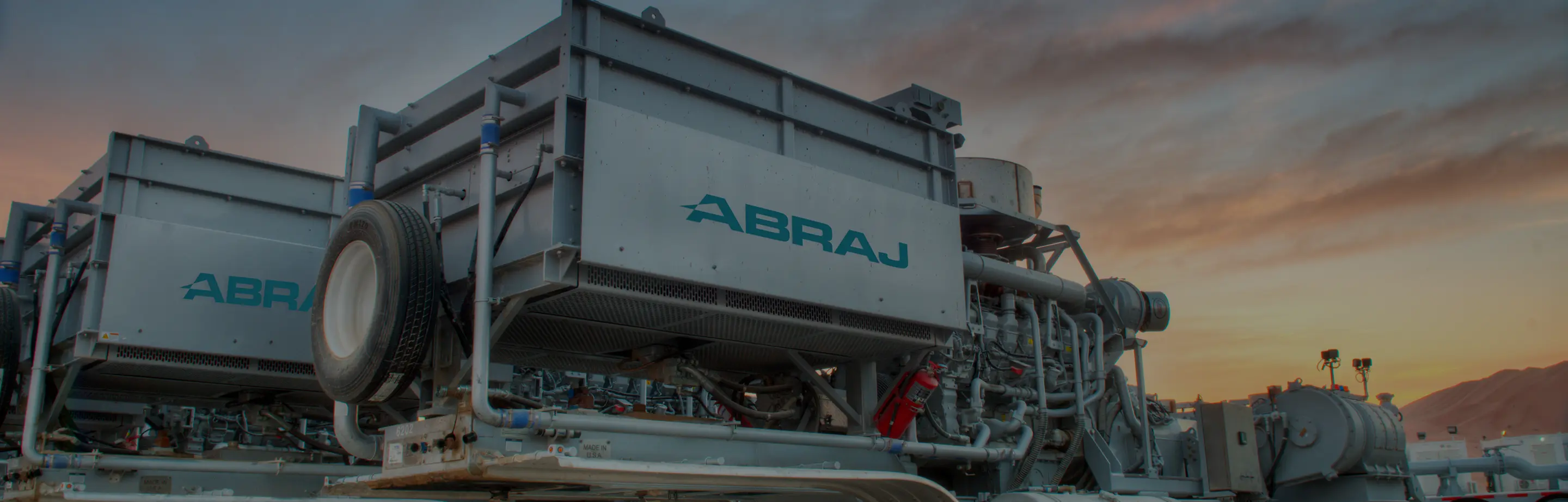
As the first company in the MENA region to provide fully integrated fracturing services, ABRAJ has advanced precision stimulation execution in challenging reservoir environments through a combination of fit-for-purpose equipment, disciplined technical planning, and operational readiness aimed at maximising hydrocarbon recovery while reducing fit-for-purpose equipment
Key performance highlights
33% market share in Oman's fracturing sector (2024)
35,000 HP hydraulic fracturing fleet capacity
30-130% production enhancement demonstrated in comparable applications
9,000+ m³ of fracturing fluid pumped annually
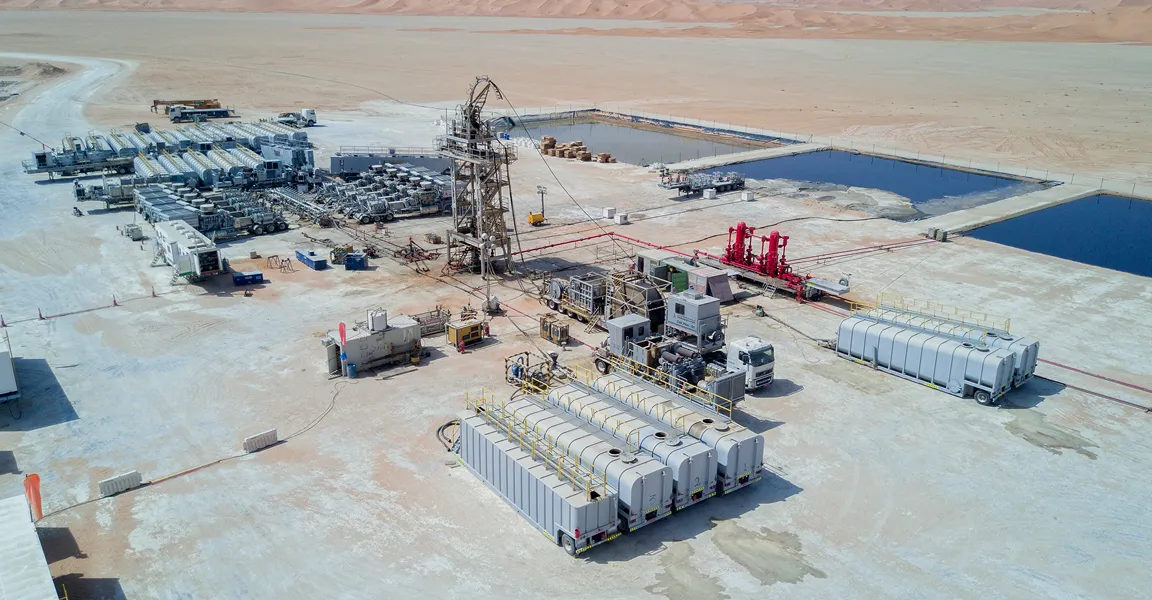
Two dedicated fracturing fleets serving PDO Central Oman Gas Fields
Technology Overview
What is multi-stage pinpoint fracturing?
Multi-stage pinpoint fracturing is an advanced stimulation technique that enables targeted fracture initiation and treatment at specific wellbore intervals. Unlike conventional approaches where multiple zones are treated together, pinpoint execution allows each stage to be designed and pumped based on its own reservoir characteristics and risk profile.
The method typically combines: coiled tubing for precise tool positioning, hydrajet (abrasive jetting) perforating to establish clean communication channels, dynamic isolation to separate stages, and real-time monitoring to optimise treatment response.
Key advantages over conventional methods
Technical Process
The pinpoint fracturing workflow
Multi-stage pinpoint fracturing follows a structured workflow built to maximise reservoir contact while keeping execution repeatable across stages.
Phase 1: Pre-treatment planning
- Reservoir characterization: Detailed analysis of petrophysical properties, stress profiles, and formation behaviour.
- Zone selection: Identification of productive intervals using log data, core analysis, and production history.
- Treatment design: Customized stage-specific fracture geometry and fluid system selection.
- Equipment mobilisation: Deployment of coiled tubing unit, fracturing spread, and monitoring set-up.
Phase 2: Execution
- Coiled tubing deployment: Precise positioning of bottomhole assembly at target depth.
- Hydrajet perforating: Abrasive jetting creates clean perforation tunnels, with penetration depths of 5–8 inches achievable.
- Dynamic isolation: Zone separation achieved through differential pressure or mechanical packers.
- Fracture initiation: Controlled pumping to create hydraulic fracture at the intended interval.
- Proppant placement: Optimized proppant concentration and volume for sustained conductivity.
- Sequential treatment: Repositioning and repeating process for subsequent zones.
Phase 3: Post-treatment
- Flowback and clean-up: Controlled fluid recovery to minimise formation damage.
- Production logging: Verification of contribution from each treated zone.
- Performance analysis: Comparison of actual results vs. design parameters.
Documented Industry Results
Pinpoint fracturing has been applied globally across diverse reservoir types, with documented performance improvements that validate the technology's effectiveness.
Global performance metrics
Production enhancement mechanisms
Reported production gains from pinpoint fracturing are typically driven by a combination of execution and reservoir-contact advantages:
- Maximized reservoir contact: Each zone receives dedicated stimulation, reducing the risk of bypassed pay seen in commingled treatments.
- Optimized fracture geometry: Treatment parameters tuned per interval to improve fracture dimensions and effectiveness.
- Clean perforations: Hydrajet perforating can create wide, clean tunnels without the crushed-zone damage associated with explosive charges.
- Uniform proppant distribution: Precise stage-level placement supports more consistent conductivity across treated intervals.
ABRAJ Energy Services Capabilities
Market leadership
ABRAJ Energy Services has established itself as the preeminent fracturing services provider in Oman, with capabilities supporting programmes across the GCC. As the first MENA-based company to launch integrated fracturing services, ABRAJ has expanded local execution capability for complex stimulation programmes, including deep and tight gas applications where multi-stage delivery and operational discipline are critical.
Current Market Position
- 33% market share in Oman's fracturing sector (2024)
- Two dedicated fracturing fleets supporting PDO Central Oman Gas Fields
- Strategic partnerships with major national and international operators
- Pre-qualified to operate in 6 countries globally
Fleet and equipment
Technical validation and industry engagement
ABRAJ’s technical capability is supported through technical publications and industry participation, including:
- IPTC-24420-MS: "Enhancing Reservoir Productivity in Carbonate Formations: Propped vs. Acid Fracturing Strategies at the Lekhwair Area" — joint technical paper with PDO presented at the International Petroleum Technology Conference (2024).
- SPE International Hydraulic Fracturing Conference 2025: Official sponsor and technical presenter, showcasing heavy oil development and record-breaking fracturing operations.
- Proprietary ABRAJ fluid systems: Customised fracturing fluid designs presented through industry conferences and technical sessions.
Regional Context: Oman's Tight Gas Opportunity
The strategic importance of fracturing
Oman’s gas growth increasingly depends on the successful development of tight gas reservoirs, where hydraulic fracturing is not optional but fundamental to commercial well performance. As Dr. Ali Al Ghaithy, Petroleum Engineering Director at PDO, has stated:
"If you look at our gas business, all our reservoirs currently are very tight and we have to frack all our gas wells. This means, to make the wells economical, we have to apply fracturing technology."
Major tight gas developments
- Khazzan Field (BP Block 61): Reported production of ~1.5 Bcf/d from tight reservoirs at 4.5–5.0 km depth, representing approximately one-third of Oman's total gas supply.
- Khulud Field (PDO): Described as “pushing the envelope” in tight gas development at ~5.5 km depth, deeper and tighter than Khazzan.
- Central Oman Gas Fields: Ongoing fracturing activity supported by ABRAJ’s dedicated fleet.
The strategic importance of fracturing
Oman’s Cretaceous carbonate formations, including Natih C1, Shuaiba, and Lekhwair, introduce stimulation challenges where zone-selective execution can be a material advantage:
- Low mobility: Realised mobility can be lower than initial projections, increasing the need for effective stimulation.
- Heterogeneity: Vertical and lateral variability often requires zone-by-zone treatment to avoid uneven stimulation.
- Treatment selection: Interval screening to determine the right approach (e.g., acid vs. propped strategies) for each zone.
- Completion efficiency: Ensuring all productive intervals contribute, rather than leaving pay behind due to commingled treatment bias.
Conclusion
Multi-stage pinpoint fracturing is a critical enabling technology for the economic development of Oman’s tight gas and complex carbonate reservoirs, particularly where heterogeneous intervals benefit from stage-by-stage stimulation and stronger control of interval contribution.
Reported outcomes in comparable applications indicate ~30% to >130% production uplift ranges depending on reservoir type and execution context. In Oman, ABRAJ’s capability to deliver integrated stimulation at programme scale is supported by its position as the first integrated fracturing services provider in the MENA region, a reported 33% market share in Oman (2024), and 35,000 HP of hydraulic fracturing fleet capacity.
ABRAJ’s technical depth is reinforced through joint technical work with PDO (including peer-reviewed conference publications), ongoing programme delivery, and continued fleet and capability investment. As Oman advances tight gas developments, demand for precision stimulation services is expected to increase, and ABRAJ is positioned to support this requirement through integrated execution, disciplined planning, and repeatable operating controls.
Download the full case study
Get the complete technical report with methodology, results, and lessons learned.
Download PDF
