.svg)


Shallow Water Flow Control
Engineered lightweight cement for aquifer isolation and top-hole well integrity in Oman — 18 of 19 wells secured across Bisat and adjacent fields, 2022–2025.



Overview
The loss–gain trap
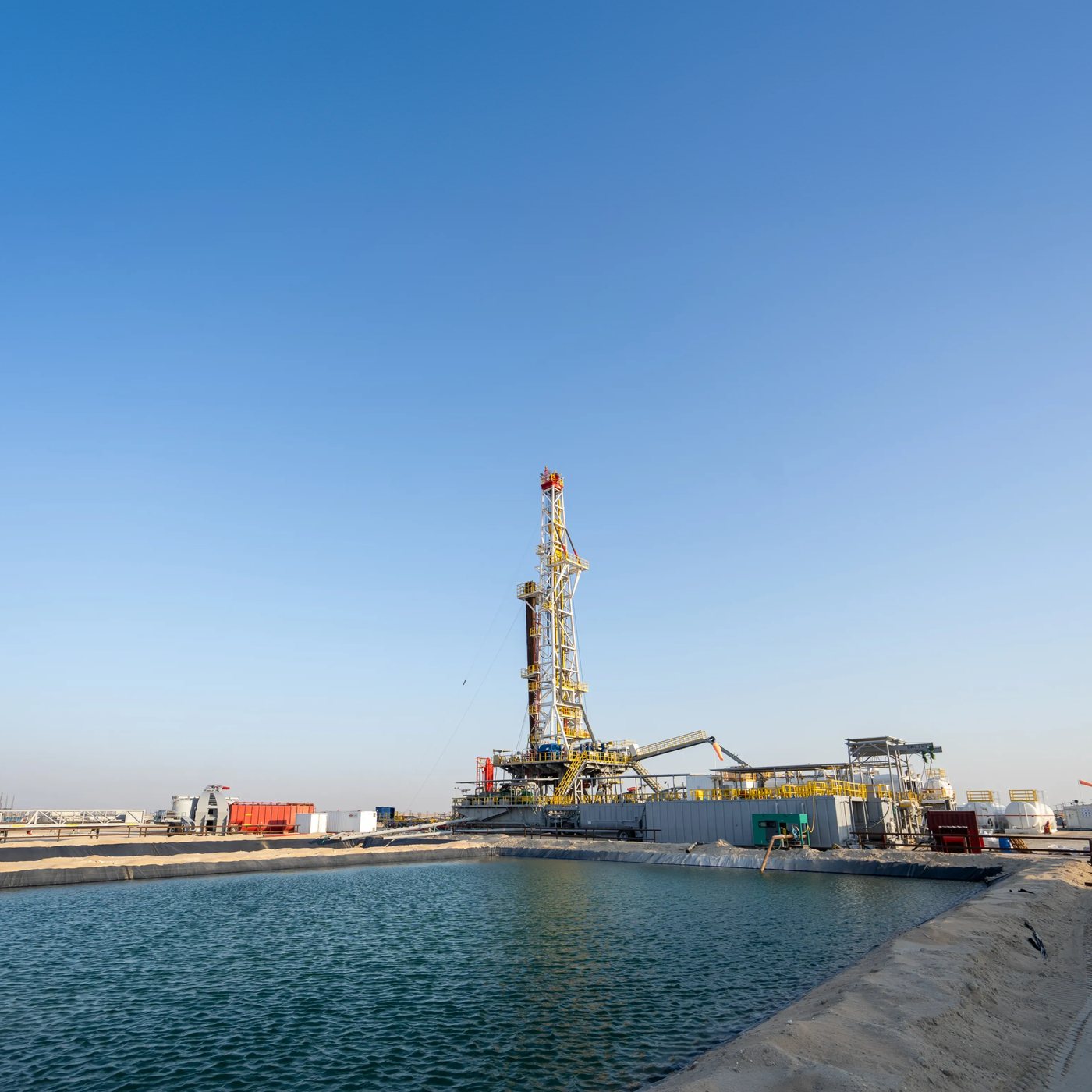
In top-hole sections in central Oman, drilling passes through pressurised freshwater aquifers where influx can escalate past 350 m³/hr in a single section. Raising mud weight to hold the aquifer breaks down a weaker zone deeper in the hole — losses first, then water gains.
How AbraLITE works
AbraLITE is an engineered high-solids lightweight cement. Its density sits inside the pressure window between aquifer pore pressure and the fracture gradient of the weakest exposed formation, and its high solid volume fraction gives it inherent bridging capability — one placement holds the aquifer and seals the thief zone.
ABRAJ's scale
ABRAJ operates cementing units across Block 60 and Block 48 and was awarded a five-year cementing services contract by OQ Exploration and Production, commencing H1 2026. Between 2022 and 2025, AbraLITE was deployed across 19 wells for OQEP; 18 were secured, and ~40% of those wells were classified as potential walk-aways.
What the white paper covers
The challenge: shallow water flow in top-hole sections
Uncontrolled influx from shallow freshwater aquifers into open top-hole sections is a well-control condition, sometimes accompanied by H₂S. In Bisat, flows have climbed from 10 m³/hr past 350 m³/hr in a single section — roughly 1,250 barrels of fresh groundwater to surface every hour at 200 m³/hr.
Why conventional cementing runs out of options
Conventional lightweight slurries reduce density by adding water, which strips the solids needed to bridge losses. Lost-circulation pills, external casing packers, stage tools and heavy cement squeezes each address one half of the loss–gain problem — none resolves both at once.
The AbraLITE approach: cement and LCM in a single placement
AbraLITE combines low hydrostatic pressure with a high solid volume fraction, engineered through particle packing rather than water addition. The high-solids blend acts as its own lost-circulation material during placement, delivering both objectives in a single placement — typically resolved on the first or second attempt.
The four-phase execution workflow
ABRAJ deploys AbraLITE through a repeatable four-phase workflow: (1) diagnosis and well assessment, (2) slurry design tuned to the specific well, (3) placement against active flow, (4) verification and fast-set top-up to surface. The workflow is what makes the technology transferable well-to-well.
Campaign evidence: 18 of 19 wells secured (2022–2025)
Between 2022 and 2025, AbraLITE was deployed across 19 wells for OQ Exploration and Production, principally in Bisat (Block 60). 18 were secured and drilled to objective; peak influx of >350 m³/hr was shut off completely, and no confirmed aquifer contamination event was reported across the campaign.
wells secured across Bisat and adjacent fields (2022–2025)
peak water influx shut off completely
of wells presented flow severe enough to justify abandonment, recovered
confirmed aquifer contamination events reported across the campaign
Get the complete technical white paper
The full white paper walks through the loss–gain mechanism, AbraLITE slurry design, the four-phase execution workflow, and the field case for well BST WDW-11. It closes with the environmental case for aquifer protection in Oman.
FAQs
